
In the world of professional degrees, few credentials carry the near-mythic prestige of a Harvard Business School (HBS) MBA. But in today’s economic landscape, prestige faces a brutal adversary: arithmetic.
With tuition, fees, and living expenses easily pushing the total cost of attendance north of $200,000 for the two-year residential program, prospective students are increasingly asking a blunt question: Is it actually worth it?
When you factor in opportunity cost—two years of forfeited salary, potential relocation expenses, and years of compounding interest on student loans—the true economic hit can approach half a million dollars.
Yet, year after year, thousands of exceptionally talented professionals pull out all the stops to secure a seat in Boston. They aren’t bad at math. They understand that an HBS MBA isn’t a standard educational purchase; it is a high-yield, lifelong asset.
Here is a look at why the $200k investment in a Harvard MBA continues to deliver an unparalleled return on investment (ROI).
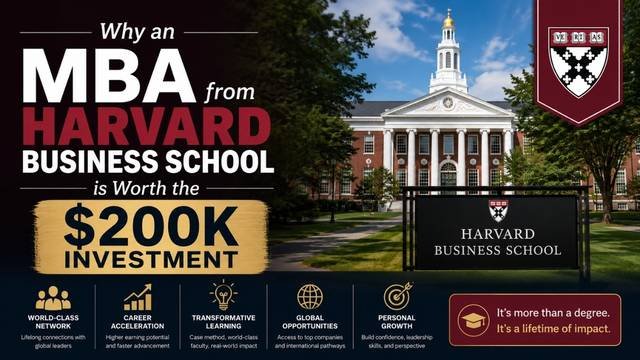
Why an MBA from Harvard Business School is Worth the $200k Investment
1. The Immediate and Long-Term Financial Trajectory
Let’s look at the hard data first. The financial return on an HBS degree materializes almost immediately upon graduation, and the compounding effect over a career is staggering.
- Starting Salaries: According to recent HBS employment statistics, the median base salary for graduating MBA students consistently hovers around $175,000 to $185,000, with median signing bonuses frequently hitting $30,000. Total first-year compensation packages regularly cross the $200,000 threshold, particularly for those entering private equity, venture capital, hedge funds, and elite management consulting.
- The Career Pivot Premium: For career switchers—those transitioning from the military, non-profits, or engineering into high-finance or tech leadership—the jump in earning potential is immediate. The degree acts as an institutional rubber stamp of competence, wiping away any perceived lack of industry-specific experience.
- The Lifetime Earnings Premium: Over a 20-year career, the wage premium of an elite MBA compared to a standard undergraduate degree or a mid-tier master’s program numbers in the millions. Harvard grads don’t just climb the corporate ladder; they are frequently handed the keys to the elevator.
2. The Unrivaled Power of the HBS Alumni Network
When you pay $200,000 to Harvard, you are paying for a lifetime pass to a global network of influence.
The HBS alumni network comprises over 85,000 individuals across more than 130 countries. But it isn’t just the size of the network that matters; it is the cultural rule of responsiveness. There is a deeply ingrained, unspoken obligation among Harvard alumni to take the call, answer the email, or mentor a fellow “Crimson.”
The Reality of High-Level Business: The most lucrative investment deals, the highest-ranking executive appointments, and the most exclusive venture funding rounds rarely happen on public job boards. They happen via warm introductions. An HBS email address gives you instant, frictionless access to CEOs, heads of state, and industry disruptors globally.
3. Mastery of the Case Method
Unlike traditional programs that rely heavily on lectures, HBS famously pioneered and centers its entire curriculum around the Case Method.
Students read up to 500 real-world business cases during their two years. Every single day, you walk into a tiered amphitheater-style classroom of 90 incredibly sharp peers. The professor doesn’t lecture; they start with a “cold call,” forcing a student to defend an strategic operational decision for a company in crisis.
- Simulated Executive Leadership: You spend two years practicing how to make high-stakes decisions with incomplete data.
- Perspective-Shifting Diversity: Because your section mates include former fighter pilots, Wall Street analysts, tech founders, and doctors, you learn to look at a single problem through ninety different strategic lenses.
- Communication Under Pressure: You learn how to speak concisely, think on your feet, and command a room—the exact soft skills required in a Fortune 500 boardroom.
4. The Institutional Venture Pipeline
If your goal is to build a company rather than run an existing one, the HBS ecosystem functions as one of the world’s premier startup incubators.
The Arthur Rock Center for Entrepreneurship provides millions of dollars in non-dilutive funding, mentorship, and access to top-tier venture capitalists. Companies like Rent the Runway, Birchbox, Cloudflare, and Blue Apron were forged in the HBS crucible.
For an aspiring founder, the $200,000 tuition fee is effectively an entry ticket to an ecosystem where elite angel investors and VCs eagerly hunt for their next seed investment. The institutional credibility of Harvard significantly lowers the barrier to raising capital.
5. Intangible Value: Credibility and Option Value
In finance, “option value” refers to the value of having choices. An HBS MBA gives you maximum career option value for the rest of your life.
Markets crash, industries become obsolete, and geopolitical landscapes shift. However, the global currency of a Harvard degree remains remarkably stable. It provides an enduring safety net and an aggressive launchpad simultaneously. If you want to pivot from tech in Silicon Valley to sustainability in Europe, or from finance in Mumbai to entertainment in Los Angeles, the degree translates universally.
The Verdict: Cost vs. Value
Is the $200,000 price tag shocking? Absolutely. Is it a financial risk? For many, yes.
However, looking at the cost of an HBS MBA as a standard expense is an analytical error. It is a capital expenditure.
If you view the $200,000 purely as payment for textbook knowledge, it is overpriced—you can find the syllabus online for free. But if you view it as an investment in a highly vetted peer group, an unmatched career accelerator, a global network of influence, and a transformative leadership boot camp, the ROI becomes undeniable.
For those ambitious enough to leverage it to its fullest potential, a Harvard MBA doesn’t cost $200,000—it pays for itself many times over.