
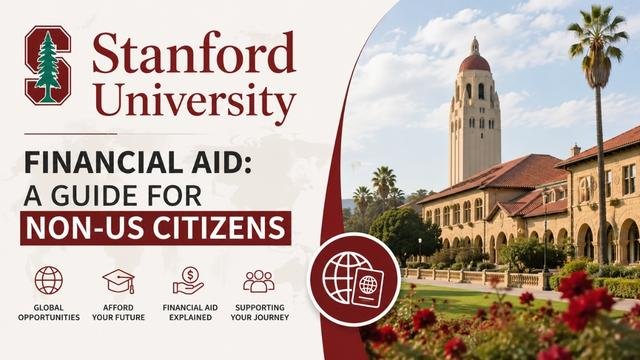
Dreaming of walking through the sun-drenched plazas of Stanford University, but worried about the eyewatering price tag? You aren’t alone. For international students, navigating the labyrinth of US college financial aid can feel like trying to decipher a complex algorithm.
Here is the good news: Stanford does offer financial aid to non-US citizens. The challenging news? The process and policies look a bit different than they do for domestic applicants.
Let’s break down exactly how Stanford’s international financial aid works, how to apply, and what you need to know to maximize your chances of securing funding.
The Golden Rule: Stanford is Need-Aware for International Students
When it comes to admissions and money, US universities generally fall into two categories: need-blind (where your financial situation doesn’t affect your admission chances) and need-aware (where it does).
Crucial Distinction: For US citizens and eligible non-citizens, Stanford is entirely need-blind. However, for non-US citizens, Stanford’s undergraduate admissions process is need-aware.
What does “Need-Aware” actually mean for you?
This means that when the admissions committee reviews your application, they will factor in how much money you are asking for.
- If you are an exceptionally strong candidate who needs full financial assistance, you can still get in and receive 100% funding.
- However, because Stanford’s budget for international aid is finite, needing financial aid makes the already razor-thin admission rate just a bit more competitive.
The Silver Lining: If you are admitted with a demonstrated financial need, Stanford promises to meet 100% of that demonstrated need for all four years. They do not use “gap” funding; if you prove you need $60,000 to attend, they will give you $60,000.
What Does Stanford’s Financial Aid Package Cover?
Stanford’s financial aid is entirely need-based, not merit-based. They do not offer athletic, academic, or talent scholarships to international undergraduates. Instead, they look at your family’s unique financial ecosystem.
Depending on your family’s income level, a typical financial aid package may include:
- Stanford Institutional Grant: Free money that you do not have to pay back.
- Student Work-Study: A part-time campus job (usually 8 to 10 hours a week) to help cover personal expenses.
- Zero Expected Loans: Stanford’s financial aid packages are designed to be “loan-free,” meaning they do not automatically insert student loans into your financial aid offer to cover your demonstrated need.
The Income Thresholds
While these figures fluctuate slightly year-to-year based on tuition hikes, Stanford’s general baseline is incredibly generous:
- Families with typical assets and income below $150,000 usually pay no tuition.
- Families with typical assets and income below $100,000 usually pay no tuition, room, or board.
Note: While these baselines are guaranteed for domestic students, they are used as the standard benchmark for determining “demonstrated need” for international students as well.
How to Apply for Financial Aid as an International Student
Applying for aid happens simultaneously with your application for admission. You cannot wait until you are accepted to ask for money. If you do not apply for financial aid during the initial application cycle, you will not be eligible to apply for aid at any point during your four years at Stanford.
Here is your step-by-step application checklist:
1. Indicate Your Intent on the Common Application
When filling out the Common Application or Coalition Application, there is a explicit question asking if you intend to apply for need-based financial aid. You must check “Yes.”
2. Complete the CSS Profile
Because non-US citizens cannot fill out the US government’s FAFSA form, Stanford uses the CSS Profile (administered by the College Board) to analyze your family’s financial health.
- Stanford’s CSS School Code: 4704
- You will need to input details about your parents’ income, assets, expenses, and local tax systems.
- Tip: If paying the CSS Profile fee presents a severe financial hardship, Stanford provides a limited number of CSS Profile fee waivers directly through their financial aid office, though College Board also automatically waives fees for certain low-income international applicants during the submission process.
3. Submit Supporting Tax and Income Documents
After submitting your CSS Profile, you will likely be required to upload supporting documentation (like your parents’ local tax returns, wage statements, or employer letters) through the College Board’s IDOC (Institutional Documentation Service) portal. All documents must be translated into English.
Deadlines to Remember
Missing a deadline can jeopardize your financial aid package. Keep these general milestones in mind:
| Application Timeline | Admission Type | Financial Aid Deadline |
| Early Action | Restrictive Early Action | November 1 |
| Regular Decision | Regular Decision | February 15 |
Smart Strategies for Non-US Applicants
Navigating this process requires strategy. Here are a few insider tips to keep in mind:
- Be Brutally Honest on the CSS Profile: Do not try to understate your need to look “more attractive” to admissions, only to realize later you can’t afford the remaining balance. If you get in but can’t afford to attend, the acceptance doesn’t do you much good.
- Look for Outside Scholarships: Because Stanford is need-aware, securing external scholarships from your home country’s government, local corporations, or international organizations (like Rotary International or the United Nations) can reduce the amount of aid you need from Stanford, making you a more competitive applicant.
- Factor in “Hidden” Costs: Stanford’s financial aid considers tuition, room, and board, but remember to budget for international health insurance, round-trip flights, and winter clothing—costs that can add up quickly.
The Bottom Line
While Stanford’s need-aware policy for international students presents an extra hurdle, it should not deter you from applying. If your academic profile is world-class and you have a compelling story, Stanford has the deep pockets necessary to make your Ivy-plus education completely free. Gather your financial documents early, pay meticulous attention to deadlines, and put your best foot forward.