
The landscape of Artificial Intelligence (AI) and robotics is moving at a breakneck pace. Technologies that were theoretical breakthroughs just a couple of years ago—like fully autonomous humanoid robots and ubiquitous generative AI agents—are now entering real-world factories, hospitals, and homes.
Choosing where to study these fields is a monumental decision. It is no longer just about learning how to code; it’s about having access to cutting-edge cleanrooms, massive computing clusters, and multi-million dollar robotics labs.
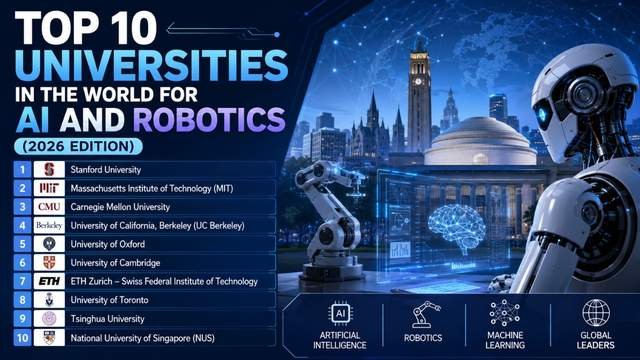
Based on the latest QS Subject Rankings for Data Science and AI, global research output, and industry partnership metrics, here are the top 10 universities in the world for AI and robotics in 2026.
1. Massachusetts Institute of Technology (MIT) – USA
- Location: Cambridge, Massachusetts
- Key Strengths: Computer Science and Artificial Intelligence Laboratory (CSAIL), foundational AI architectures, biomimetic robotics.
MIT continues to sit undisputed at the top of global tech rankings. CSAIL is one of the world’s largest and most famous hubs for computer science research, housing hundreds of parallel projects. From the development of advanced neural networks to pioneering nimble, cheetah-like quadruped robots, MIT bridges the gap between hardware and software perfectly. Students here work directly alongside industry pioneers and regularly launch heavily-funded startups.
2. Stanford University – USA
- Location: Stanford, California
- Key Strengths: Stanford Artificial Intelligence Laboratory (SAIL), Silicon Valley pipeline, autonomous driving, and human-centered AI.
Situated in the heart of Silicon Valley, Stanford is the ultimate breeding ground for tech founders and cutting-edge researchers. SAIL has been a pioneer in computer vision, natural language processing, and autonomous vehicles for decades. Furthermore, Stanford’s Institute for Human-Centered AI (HAI) ensures that students don’t just build smart machines, but also study the ethical, societal, and economic impacts of automation.
3. National University of Singapore (NUS) – Singapore
- Location: Singapore
- Key Strengths: Smart nation integration, industrial automation, medical robotics.
Ranked as the top university outside the United States, NUS is a global powerhouse. Backed by Singapore’s massive national investments in automation, NUS excels in creating highly practical, real-world robotic systems. Their research in medical robotics (such as surgical assistants) and autonomous maritime vehicles is industry-defining. If you want to study in an ecosystem where the government actively deploys university-made AI into the city’s infrastructure, NUS is the place to be.
4. Carnegie Mellon University (CMU) – USA
- Location: Pittsburgh, Pennsylvania
- Key Strengths: The Robotics Institute (RI), the world’s first Machine Learning Department, field robotics.
While MIT and Stanford are often household names, tech insiders know that CMU is an absolute titan in this specific niche. CMU established the world’s very first Robotics Institute in 1979 and offers some of the most specialized, rigorous degrees on Earth. The institution specializes in “field robotics”—building autonomous systems capable of navigating harsh environments like deep oceans, volcanic craters, and outer space.
5. Nanyang Technological University (NTU) – Singapore
- Location: Singapore
- Key Strengths: Cognitive robotics, human-robot interaction, AI-driven materials science.
Hot on the heels of its domestic neighbor, NTU Singapore ranks exceptionally high for its sheer volume of high-impact AI research citations. NTU is globally renowned for its work in social and cognitive robotics—developing machines that can seamlessly interact with human beings in social, educational, and caregiving settings. Their state-of-the-art labs focus heavily on deep learning and multi-sensor fusion.
6. University of California, Berkeley (UC Berkeley) – USA
- Location: Berkeley, California
- Key Strengths: Berkeley Artificial Intelligence Research (BAIR) Lab, open-source AI, reinforcement learning.
UC Berkeley’s BAIR Lab brings together over several dozen faculty members and hundreds of graduate students across computer vision, robotics, and NLP. Berkeley is famous for its culture of open-source innovation, contributing massive foundational tools to the global AI community. It is a premier institution for studying reinforcement learning—the exact machine learning methodology used to train robots how to walk, grasp objects, and adapt to unpredictable environments.
7. University of Oxford – United Kingdom
- Location: Oxford, United Kingdom
- Key Strengths: Oxford Robotics Institute (ORI), deep reinforcement learning, autonomous vehicles.
Oxford represents Europe’s finest offering in the AI space. The Oxford Robotics Institute focuses heavily on mobile autonomy, transforming standard machines into self-driving cars, mapping drones, and smart industrial inspection systems. Oxford’s deep ties with deep-tech spin-offs and the UK’s thriving AI ecosystem make it a magnetic hub for international researchers looking to transition from academia to commerce.
8. Tsinghua University – China
- Location: Beijing, China
- Key Strengths: Industrial automation, massive computational research, computer vision, hardware accelerators.
Tsinghua University routinely dominates global charts when it comes to the sheer volume of engineering publications and citations. It is the premier tech pipeline for China’s booming automation and electric vehicle industries. Tsinghua excels at creating the physical computing hardware—like AI microchips and neural processing units—that makes modern robotics computationally viable.
9. Harvard University – USA
- Location: Cambridge, Massachusetts
- Key Strengths: Harvard Microrobotics Laboratory, soft robotics, bio-inspired engineering.
While Harvard is traditionally celebrated for its humanities, law, and medicine, its John A. Paulson School of Engineering and Applied Sciences has quietly become a world-renowned leader in niche robotics. Harvard is particularly dominant in soft robotics and microrobotics. Instead of rigid metal machines, researchers here build flexible, tissue-like robots designed to navigate the human bloodstream or perform delicate surgical maneuvers.
10. ETH Zurich – Switzerland
- Location: Zurich, Switzerland
- Key Strengths: Robotic Systems Lab, drone technology, cyber-physical systems.
As one of Europe’s most prestigious technical universities, ETH Zurich is world-renowned for its mechanical precision and algorithmic design. If you have ever seen videos of highly agile, acrobatic drones navigating dense forests or collaborating to construct complex architectural structures, you are likely looking at ETH Zurich’s research. Their multi-disciplinary approach seamlessly blends mechanical engineering, control systems, and machine learning.
Which University is Right for You?
When choosing a university for AI and robotics, looking at rank alone isn’t enough. You must consider your specific sub-field:
| If your primary focus is… | You should target… |
| Pure Machine Learning & Software | Stanford, UC Berkeley, Tsinghua |
| Heavy Hardware, Drones & Dextrous Robots | MIT, CMU, ETH Zurich |
| Social, Medical & Human-Robot Interaction | NTU, NUS, Harvard |
What to Look For Beyond the Rankings:
- Lab Funding: Check how much funding a lab receives from corporate giants like Google, Nvidia, or Boston Dynamics, as this dictates the equipment you will get to use.
- Spin-off Success: Look at how many startups originate from the university’s engineering departments.
- Geographical Ecosystem: Proximity to tech hubs (like Silicon Valley, Shenzhen, or Singapore) drastically changes your internship and post-graduation employment prospects.
As autonomous systems continue to redefine human capability, graduating from any of these institutions guarantees you a front-row seat to the future.
If you want a deeper look at what it takes to get into these top-tier engineering ecosystems, check out this guide on the Top 20 Universities for Artificial Intelligence and Robotics, which breaks down program structures, campus lab environments, and what life looks like for an international student pursuing a cutting-edge degree.